
the mean 8
every 8 the museum can find, laid on top of every other
The museum holds thousands of 8s and had, until now, never seen them all at once. This is the attempt: every work in which a text-detection model could find the 8, cropped to the glyph, scaled to a common height, and averaged — one exposure on top of another, like a photograph left open for two and a half years. One step precedes the averaging: because a pale 8 and a dark one laid on top of one another simply cancel out, the pale ones were reversed to a negative so that all of them read dark on light — 2,158 of the 3,757. For the same collection with none of those decisions made, see the mean photograph.

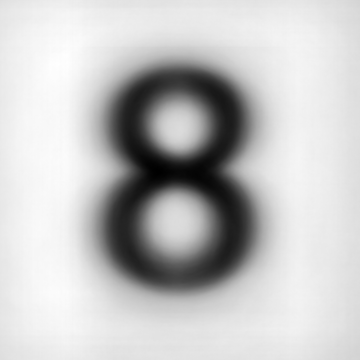 the mean, in light
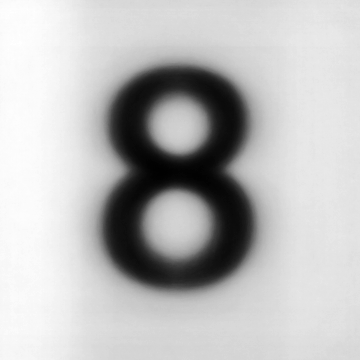 the median — the typical, not the average
 the mean, in colour, as found
what the composite shows
observations entered in the register
The 8 survives averaging. Thousands of unrelated objects — enamel plates, carved stone, neon, tile, spray paint, pressed metal — agree, when stacked, on a single form. Nothing in the archive was made to match anything else in it; the resemblance is the world's, not the museum's.
The upper loop is the smaller. Across the whole collection the top loop of the 8 averages narrower and shorter than the lower — the convention of nearly every typeface and nearly every hand, arrived at here by accumulation rather than by design.
The edges dissolve. Away from the glyph the composite fades to an even field. The backgrounds of the archive — walls, sky, pavement, water, rust — cancel one another out completely. What remains is the only thing every photograph had in common.
The mean 8 is slightly to the left. A faint asymmetry survives the averaging, which the committee attributes to the practitioner's stance and declines to correct.
method
how the composite was made, and what it leaves out
Location. Each photograph was passed to a scene-text detector, which returns the position of any digit it can read — and passed twice: once as it stood, and once inset into a canvas three times its size, since a detector built to find small writing within a scene will otherwise overlook a glyph that fills the frame entirely. Axiom 4 does the museum an unexpected favour here: because no other complete numeral may appear in the frame, an 8 found by the machine is almost always the 8.
Alignment. Every located 8 was cropped to a square scaled by the glyph's own height, so that a house number on a Lisbon door and a painted 8 four storeys tall on a Berlin wall arrive at the same size.
Polarity. Roughly half the collection is dark-on-light and half light-on-dark; averaged together they would erase each other. Each crop in which the 8 was the paler of the two was therefore reversed to a negative, so that every 8 reads dark on light before averaging. The museum notes that this is the one liberty taken, and that no photograph was altered — only its copy, and only in arithmetic.
What escapes. Some 8s were never writing, and no detector will read them at any size: the 8 grown into a tree-knot at Sofia, the moss proto-8 of Chermsideøya, the door knocker at Palma, or the dust ghost at Lesbos — the works the committee admitted precisely because they were not writing. Those 8s are absent from the composite. They are present in the mean photograph, which needs no detector and so admits them on the same terms as the rest.
The composite is recomputed as the archive grows, and will be complete — in the only sense the museum recognises — at 8,888. The committee, shown the result, observed that the museum had at last acquired a portrait of itself, and asked whether it had always looked like that.