The length of the thread. Joining each work to the next in the order it was encountered — within each day of fieldwork — gives a path of 89,874 kilometres: 2.24 times around the earth, walked, ridden, sailed, and flown, one 8 at a time.

the register of measurements
the museum measured against itself
The archive was assembled one photograph at a time, with no view of the whole. Taken together, however, its coordinates and timestamps describe a body with dimensions: a centre, a reach, a pace, and a number of records nobody set out to break. What follows was computed from the collection's own metadata. No work was revisited, and nothing here was known at the time of noticing.
the centre of mass
where the collection balances
Averaged over the surface of the earth, the museum's 8,448 located works balance at 37.46°N, 87.02°E — in the Taklamakan Desert, in Xinjiang, in western China, some 102 kilometres from the nearest named settlement. The museum holds nothing there, has never been there, and has no prospect of going. It is nonetheless the institution's centre of gravity: a point in a cold desert, arrived at by two and a half years of walking somewhere else entirely.
The point moves. Each accession tugs it, and the plate below records its progress — from central Australia, where the practice began and the centre briefly sat almost on top of it, north and west across Asia as Europe and, latterly, the Arctic entered the collection. The ground beneath the path is the collection itself: every located work, plotted faintly, which is the only world map the museum keeps.
the drift of the centre of mass, numbered as in the register below · the museum's 8,448 located works in ivory; behind them, faintly, the inhabited world, drawn as settlement rather than coastline · equal earth, the projection the united nations adopted on 4 september 2026; the galleries went equal-area two days later, the offices ten
jun 202419.75°S, 132.52°E593 works
dec 202417.67°N, 93.53°E2,091 works
jun 202527.13°N, 90.13°E4,288 works
dec 202529.13°N, 95.90°E6,768 works
jun 202629.38°N, 95.73°E7,622 works
today37.46°N, 87.02°E8,448 works
The centre crossed the equator northward between June and December 2024, and has not returned. The committee, asked whether the museum should visit its own centre, has undertaken to consider the question once the point stops moving — which is to say after the 8,888th accession, when its coordinates become final. It observes that the practice has never been to the Taklamakan, that the museum is therefore not there in the only sense the museum recognises, and that the odds of the desert holding an 8 — absent the intervention of wind, mouse, or remarkable luck — do not favour the trip. On present evidence the committee would rather go for a walk. It notes one further curiosity of the plate: between December 2025 and June 2026 the centre moved twenty-five kilometres, the museum's last months in Sydney and its first in Corfu pulling against each other and cancelling almost exactly, so that positions 4 and 5 share a single mark. The move to Europe registered only afterwards, in the summer's fieldwork, which by mid-September had carried the centre some two thousand kilometres to the north-west.
the thread
the collection in the order it was found
The ground actually covered. Where consecutive encounters lie less than three kilometres apart — which is to say, where the museum was on foot — the thread measures 925 kilometres. This is the museum's lower bound on noticing done at walking pace, and the committee considers it the more honest of the two figures.
On the eighty-eight thousandth kilometre. The thread passed 88,888 kilometres on 14 August 2026, en route to the fieldwork that became the Paris Annex, and did not stop there; it now overshoots that figure by some 986 kilometres. The committee, which had not been watching the odometer and would have very much liked to, records its displeasure with a universe that declined to halt the practice at so outrageous a number, and notes that nothing whatsoever can be done about it.
The loneliest work. A single 8 in Australia stands 198 kilometres from its nearest companion in the collection — the greatest distance any work keeps from every other. The museum's second-loneliest, in Germany, manages 168 kilometres; its third, on Svalbard, 120.
the walk
what the wrist records
The distance walked. Between the first encounter on 25 January 2024 and the 8,888th on 2 September 2026 — 952 days, none of them still — the museum walked 5,290 kilometres: 6,555,110 steps, 8,219 floors, a little under six kilometres a day. The thread, above, measures only the ground between one work and the next; the wrist measures the rest, and the rest is most of it. Most of the walking found nothing, which the committee considers the correct proportion.
The yield. One 8 for every 597 metres, averaged over everything. The average conceals the rule, which is whether before how many: on a day of under two kilometres the museum met an 8 one time in four; over eight kilometres, three times in four; over fifteen, nine times in ten, with a median of thirty-three. The day's distance and the day's count move together (Spearman's ρ = 0.44 across the 952 days), and only the day's — yesterday's walk predicts today's works not at all. The coupling tightened as the practice learned itself: 0.27 in 2024, 0.58 in 2025, 0.63 in 2026.
Home and away. In Sydney the museum found 3.1 works a day, or 0.63 to the kilometre; in Corfu, since the move, 2.3 a day and 0.39 to the kilometre — a small town, harvested fast. Away from either it found 21.8 a day and 3.3 to the kilometre, on days only a kilometre or so longer. Streets already walked give up little that is new. The remedy, if a remedy is wanted, is to walk others — and the eye keeps adjusting regardless: lately it finds the shape in stones, in bark, in the marks on floors, where nobody wrote it. The committee's advice, addressed to itself, is the same in either case: keep walking.
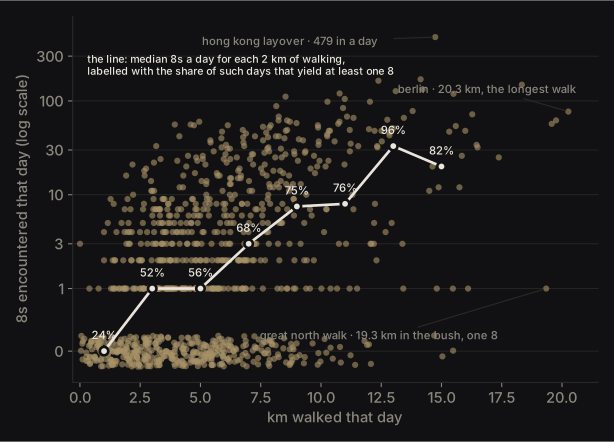
one dot a day: how far the body went against what the eye brought back · the line is the median, labelled with the share of days that yielded at all
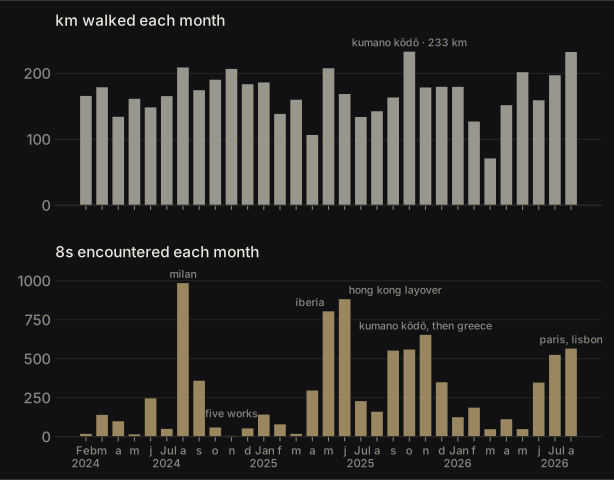
the walk is steady and the finding is not · a month's count is set by where the walking happened; a day's, by how far
The walk is measured from the wrist, not the register: steps and walking distance as Apple Health recorded them, de-duplicated across watch and phone, each day cut by the local clock of wherever the museum was. These figures, and the air's below, were taken at completion and are the only ones on this page that do not refresh.
the air
what the flight log records
The distance flown. 282,838 kilometres, on 87 flights and 403 hours aloft — sixteen and a half days, or 1.8 per cent of the period, spent between airports. One flight produced an 8: 8M·dda959d4, the face of the watch reflecting cloud somewhere over Fontainebleau, 21 May 2025. The travel was the shape of the life before the register existed; the museum went where the life went and looked down.
The longest and the shortest. Sydney to Vancouver, 12,501 kilometres in twelve hours, on 5 February 2025; and Vardø to Vadsø, 55.5 kilometres in twenty minutes, on 10 July 2026 — a flight the museum could have walked in three of its longest days. That July day held six flights along the Finnmark coast, 579 kilometres in all, and 24 works were met in the gaps between them.
The hinges. Forty-three airports. Sydney, with 25 arrivals and departures; Corfu, 15; Hong Kong, 14 — the hinge between the two homes, and the site of the busiest day in the register, which was a layover. The equator was crossed seventeen times. On 59 of the 69 days that had a flight in them, an 8 was met somewhere regardless.
every flight of the period as a great-circle arc, drawn on the same map — which remains the only one the museum keeps · an arc is the shortest way, not the way the aircraft went
the pace
what the calendar records
Days of fieldwork. The museum has accessioned works on 538 separate days, out of 938 since the first encounter — a working rhythm of roughly four days in seven, sustained without a schedule.
The longest silence. The collection has never gone more than 12 days without an accession. Three separate occasions hold the record jointly; on each, the museum simply resumed.
The longest streak. 28 consecutive days bearing at least one encounter, from 20 October to 16 November 2025 — the pilgrimage months, when the practice and the walking were the same activity.
The busiest day. 479 works on 5 June 2025 — more than five per cent of the entire museum, encountered between one sunrise and the next. The record is not expected to fall.
the coincidences
submitted to the committee, which declines to draw conclusions
Works found at eight minutes past eight. 9, morning or evening. A further 139 were found at eight minutes past some other hour, and 621 in the eighth hour of the morning or evening.
Works found on the eighth of a month. 282. Of these, 14 were found on the eighth of the eighth.
Works standing in the eighth degree. 265 works lie within the eighth degree of latitude or longitude — the band the museum's standing research programme was established to watch.
Flights taken in row 8. 4 of the period's 87, the shortest flight in the log among them.
One short. The log closes at 87 flights. The committee, which had not been counting and noticed only on adding up, records a disappointment it is careful to describe as slight: an eighty-eighth flight, had it arrived on its own, would have been received with delight; a flight taken in order to arrive at it would have been received with something else. The number stands. The committee has asked before that nobody deliberately arrange a coincidence, and finds, to its mild regret, that it meant it.
The perfect coincidence. None. No work in the archive was encountered on the eighth day of a month at eight minutes past eight. The committee, which had considered that the museum might stumble into one eventually, has entered the absence in the register and asked that nobody deliberately arrange it.
the reach
the outermost works, wherever they stand
North. 81°36′N — seven works encountered on 30 June 2026 in the sea north of Svalbard, beyond the archipelago's last land. They are the museum's northernmost holdings by a margin of some seventy kilometres, and stand one short of the eight an annex requires.
South. 38°24′S — on the Victorian coast, south-west of the Melbourne Annex, which retains the institutional title while this work holds the fact.
East. 153°15′E — near Ballina, on the New South Wales coast, an arrangement the Brisbane Annex has already accepted.
West. 125°55′W — three works on the open Pacific coast of Vancouver Island, encountered on 13 February 2025. They stand two degrees west of Gabriola, which the register still credits with carrying the title west.
The hemispheres. 6,074 works north of the equator to 2,374 south; 8,079 east of Greenwich to 369 west. The museum is, on the evidence, an eastern and northern institution that began in the south.
All figures but the walk's and the air's are computed from the archive's own metadata and refresh with each accession. The committee reminds readers that none of these measurements was an aim of the practice, and that a museum which set out to break them would be a different museum, and a worse one.